Hybrid Horizons: De-Risking the Path to Offer-Order Transformation
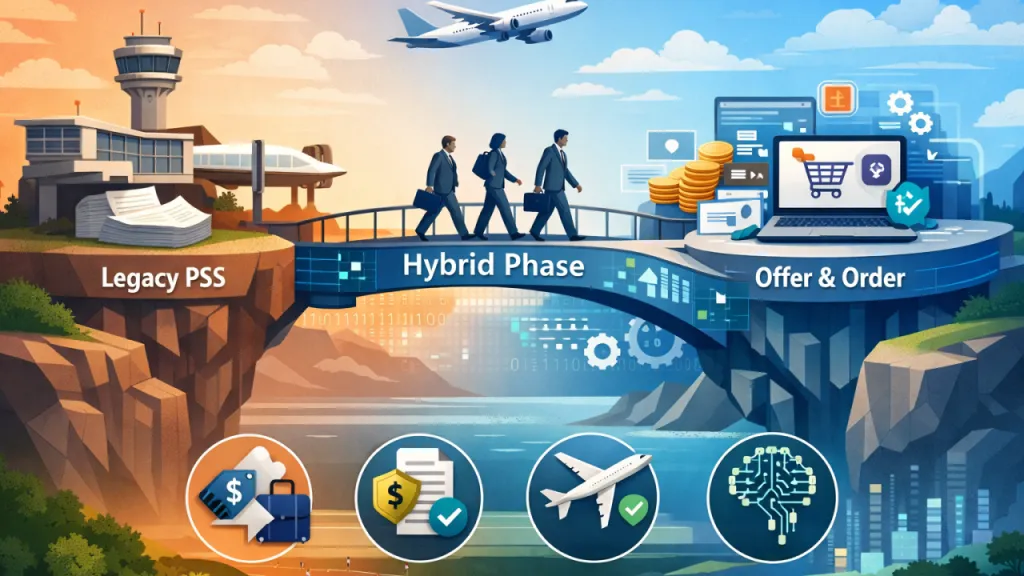
The airline industry is amid a major retailing transformation. Order-based retailing - built on IATA’s Offers & Orders framework - promises dynamic, personalized offers, seamless fulfilment, and stronger ancillary revenue. Yet for most carriers, moving from legacy passenger service systems (PSS) to a full order-led model feels high-risk. Disruption, data inconsistencies, and the cost of running dual systems for an extended period are real concerns.
A recent webinar hosted by Cory Garner of airline retailing advisory firm Garner, “Real-World Offer-Order Modularity: Logistics, Governance, & Benefits” (February 12, 2026), provided a practical response. Experts from OpenJaw Technologies , PROS Travel , Piano , Airnguru , Lufthansa Systems , and iPort -- fresh from their live end-to-end demo at a recent International Air Transport Association (IATA) event in Geneva -- demonstrated that transformation does not require a big-bang switch. Through hybrid coexistence, phased rollouts, and open modular architectures, airlines can de-risk migration while capturing early value. The discussion showed that hybrid is a deliberate, value-creating phase that bridges legacy and future systems.
Phased Rollouts: Low-Risk Entry Points
The panellists stressed that airlines should not attempt a complete replacement in one go. Instead, they should introduce modular components selectively and expand as confidence grows.
The Geneva demo itself used a legacy-free flow for flights, ancillaries, orders, accounting, and delivery, relying upon bespoke APIs in areas where full standards are still developing. This flexibility allows airlines to start with low-risk functions such as ancillary merchandising or pricing while the PSS continues to handle core booking and settlement.
Replacing pricing first was presented as a realistic 6–9 month starting point, with significant opportunity available even before standards fully mature. Context-aware ancillary recommendations and dynamic bundles can generate revenue in the early stages, building momentum for broader order integration.
Finance and settlement were highlighted as strong early candidates because modular accounting can run in parallel and reconcile with legacy records until the transition is complete. Pascal Grebe of Lufthansa Systems was asked how to “keep finance happy while the legacy PSS is still live, and who owns the golden order record?” He explained that modular settlement can mirror legacy records during the hybrid phase, reducing audit risk and operational shock while the golden record gradually migrates to the new system. This phased approach limits operational exposure, builds internal support, and allows airlines to gain experience with order-based processes while the PSS remains in place for core functions.
Data Mastery Across Environments
Running legacy and modular systems together multiplies data sources, making consistency essential for personalization, reconciliation, and compliance.
Behavioural analytics and segmentation data can feed personalization across both environments while complying with GDPR and avoiding PII storage. The panellists noted that airlines were particularly impressed by the practical application of this data for real-world personalization rather than theoretical concepts.
AI and machine learning can optimize assortment and bundle content using information gathered from offer and order systems. In hybrid mode, a strong governance layer -- often centred on the modular order hub -- pulls insights from both legacy and new sources, ensuring consistent traveller experiences and revenue opportunities.
Continuity During Transition
The panel explained how airlines can maintain continuity of operations and accounting through hybrid transition phases. Disruptions such as delays, cancellations, or system outages are inevitable. Delivery modules can intelligently switch between order and PSS data sources based on availability and context. Thomas Brophy of iPort noted that if an order system becomes unavailable on a flight, “we have to be able to get passenger information… without disruption.” Flight-level granularity during the hybrid phase ensures boarding proceeds even if one system falters.
Finance continuity is achieved through parallel reconciliation, with modular settlement mirroring legacy records until the “golden order record” fully migrates to the new system. This fail-over capability prevents cascade failures and keeps passengers unaffected as the architecture evolves.
Key to the overall transition process is the role of the systems integrator. The system integrator helps the airline manage vendor relationships under a single contract and program management regime, reducing complexity and allowing airlines to focus on benefits rather than coordination.
Openness as the Multiplier
While modularity enables phasing, openness multiplies its value via public APIs, vendor-agnostic interfaces, and flexible governance.
Not everything is standardized at this point, but openness allowed the demo to succeed with bespoke integrations. System integrators will likely define de facto standards in the interim, pushing the ecosystem toward greater interoperability.
Openness enables airlines to test GenAI-driven offers, swap vendors as needs evolve, and maintain procurement leverage, thereby avoiding the lock-in risk of closed modular systems. This flexibility becomes controlled progress, allowing carriers to iterate without full commitment.
Conclusion: A Pragmatic, Future-Proof Journey
The webinar also covered personalization without PII, AI/ML for bundles, standards evolution, SLAs/governance, and early production examples. These topics reinforce that hybrid is a value-creating phase that bridges legacy and future while de-risking the journey.
Whether you’re planning your first hybrid pilot or scaling group-wide, the message is clear: phased, open modular retailing is the pragmatic, future-proof path forward.
For the full discussion, including the demo replay, airline feedback, and live Q&A, view the webinar recording at - https://youtu.be/_52CW8e15vs.